Time and Time Again These Ment Struggle and Sacrifice Willy Harrington
| Cathleen ni Houlihan | |
|---|---|
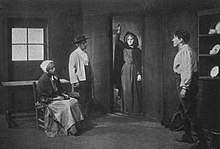 Scene from a production c. 1912. | |
| Written by | Lady Gregory |
| Engagement premiered | two April 1902 (1902-04-02) |
| Place premiered | Dublin |
Cathleen ni Houlihan is a comedy play written by William Butler Yeats and Lady Gregory in 1902. Information technology was first performed on ii April of that twelvemonth and outset published in the October number of Samhain. Lady Gregory wrote the naturalistic peasant dialogue of the Gillane family, while Yeats wrote Cathleen Ni Houlihan'south dialogue.[1]
Maud Gonne portrayed Cathleen ni Houlihan in the play'south first performances at St. Teresa's Hall, Clarendon Street, Dublin. The play centres on the 1798 Rebellion. The play is startlingly nationalistic, in its terminal pages encouraging young men to sacrifice their lives for the heroine Cathleen ni Houlihan, who represents an independent and carve up Irish state. The championship character first appears equally an old woman at the door of a family unit celebrating their son's nuptials. She describes her four "beautiful green fields," representing the iv provinces, that accept been unjustly taken from her. With petty subtlety, she requests a blood cede, declaring that "many a kid volition exist born and at that place volition be no father at the christening". When the youth agrees and leaves the condom of his domicile to fight for her, she appears equally an image of youth with "the walk of a queen," professing of those who fight for her: "They shall be remembered forever, They shall be alive forever, They shall be speaking forever, The people shall hear them forever."[ii]
The premiere of Cathleen Ni Houlihan initially dislocated Dublin audiences who had expected a comedic play due to the actor Willie Fay's prior association with comedies.[3] Still, Gonne's reputation as an ardent nationalist helped them to understand the "tragic meaning" of her role, equally described by Yeats.[3] By the 3rd night the theatre was so crowded that customers had to exist turned away.[3]
Yeats afterward expressed reservations well-nigh the play's nationalistic rhetoric of blood cede, asking in a later poem, "The Man and the Echo," "Did that play of mine send out / Certain men the English shot?"[4]
Characters [edit]
Peter Gillane, a farmer
Michael Gillane, his eldest son
Patrick Gillane, his youngest son
Bridget Gillane, Peter's wife
Delia Cahel, Michael's fiancée
The Poor Old Adult female / Cathleen Ni Houlihan
Neighbours
Synopsis [edit]
The play is set in Killala in 1798. The Gillane family unit are discussing the upcoming marriage between their son Michael and his fiancée Delia. Peter and Bridget are concerned with obtaining Delia's dowry. They hear cheering outside but are unconcerned with its cause. Michael enters and tells his parents that he has visited the priest to accommodate the wedding ceremony for the post-obit day. He gives the dowry to his parents. The family is visited by a mysterious old woman. She tells them that her "four beautiful green fields" have been stolen from her.[5] She sings about patriots who have died for Ireland and reveals herself as Cathleen Ni Houlihan. She tells them that many men have died for her and that more must make sacrifices in gild to help her regain her fields and banish the strangers who stole them. Neighbours enter the house and Patrick tells his family that the French ships accept landed at Killala bay. The 1798 Rebellion is taking identify. Michael is enchanted by Cathleen's words and vows to join the French army, abandoning his parents and his fiancée despite their pleas. Cathleen leaves, saying that "They shall exist speaking for e'er, / The people shall hear them forever."[six] Peter asks his son Patrick if he saw an old woman leaving, only Patrick tells him that he saw a young girl who had "the walk of a queen."[vi]
Themes [edit]
The play has themes of nationalism and blood sacrifice. Colm Tóibín describes Michael as an "idealistic, inspirational" male hero in the tradition of Lady Gregory's plays The Rising of the Moon and Gaol Gate, and the Irish mythological hero Cuchulainn, because he is willing to sacrifice his life for his newfound nationalistic beliefs, unaffected past the "land-hunger" which occupies his family unit.[seven] Susan Cannon Harris contrasts the play's delineation of the "male patriot" who makes a blood sacrifice which "symbolically regenerates" Ireland, with the female peasant characters who face the arduous tasks of economic reality which make this regeneration possible.[one] Michael abandons the everyday concerns of dowries, wedding clothes and land purchases in order to follow Cathleen and surrender his life for the nationalist cause.
Cannon Harris describes the significance of Maud Gonne's performance as Cathleen Ni Houlihan in expressing the play'south nationalist themes. Gonne'south reputation every bit a nationalist apostle and public speaker added to the play'due south popular appeal. Her disguise equally an elderly adult female illustrates that the Poor Old Adult female is only a veneer who conceals the "uncorrupted essence" of Irish gaelic liberty.[8]
Nicholas Grene examines the trope of "strangers in the business firm" which is used in unlike contexts throughout the play.[nine] The British invaders have stolen Cathleen Ni Houlihan'south state and exiled her, forcing her to wander the roads in search of help. The French invaders are seen as "necessary catalysts" for the adjournment of the British, while Cathleen herself is a disrupting presence when she visits the Gillane family unit's abode and presents them with a by vision of Irish independence which could be accomplished in future.[9]
References [edit]
- ^ a b Cannon Harris, Susan (2002). Gender and Modern Irish Drama . Indiana: Indiana University Press. pp. 61. ISBN0-253-34117-5.
- ^ West. B. Yeats, Nine I-Deed Plays (1937), p. 36.
- ^ a b c Quinn, Antoinette (2009). "Cathleen Ni Houlihan Writes Back". In Harrington, John P. (ed.). Mod and Contemporary Irish Drama. New York: Westward.W. Norton and Company. p. 431. ISBN978-0-393-93243-0.
- ^ Macrae, Alisdair D. F. (1995). Dutton, Richard (ed.). W.B. Yeats: A Literary Life. Dandy Great britain: Gill & MacMillan. p. 66. ISBN0 7171 2225 v.
- ^ Gregory, Lady Augusta; Yeats, W.B. (2009). "Cathleen Ni Houlihan". In Harrington, John P. (ed.). Modernistic and Gimmicky Irish Drama. New York: W.West. Norton and Visitor. p. seven. ISBN978-0-393-93243-0.
- ^ a b Gregory, Lady Augusta; Yeats, W.B (2009). "Cathleen Ni Houlihan". In Harrington, John P. (ed.). Modern and Contemporary Irish gaelic Drama. New York: West.W. Norton and Company. p. 11. ISBN978-0-393-93243-0.
- ^ Tóibín, Colm (2009). "The Collaborations of Yeats and Lady Gregory". In Harrington, John P. (ed.). Mod and Contemporary Irish Drama. New York: W.W Norton and Company. p. 420. ISBN978-0-393-93243-0.
- ^ Cannon Harris, Susan (2002). Gender and Modern Irish Drama . Indiana: Indiana University Press. pp. 62. ISBN0-253-34117-five.
- ^ a b Grene, Nicholas (2009). "Strangers in the Business firm". In Harrington, John P. (ed.). Modern and Gimmicky Irish Drama. New York: Due west.West. Norton and Company. pp. 428–429. ISBN978-0-393-93243-0.
External links [edit]
- Literary Encyclopedia: Cathleen ni Houlihan
- Ireland 32 Periodical Essay
- The National Library of Ireland'south exhibition on Yeats; features many manuscript drafts of this play and photographs from the 1902 production featuring M Gonne.
- The Unicorn from the Stars and Other Plays at Project Gutenberg
Source: https://en.wikipedia.org/wiki/Cathleen_ni_Houlihan
0 Response to "Time and Time Again These Ment Struggle and Sacrifice Willy Harrington"
Enviar um comentário